Digital course
The Case Narrowing Method™
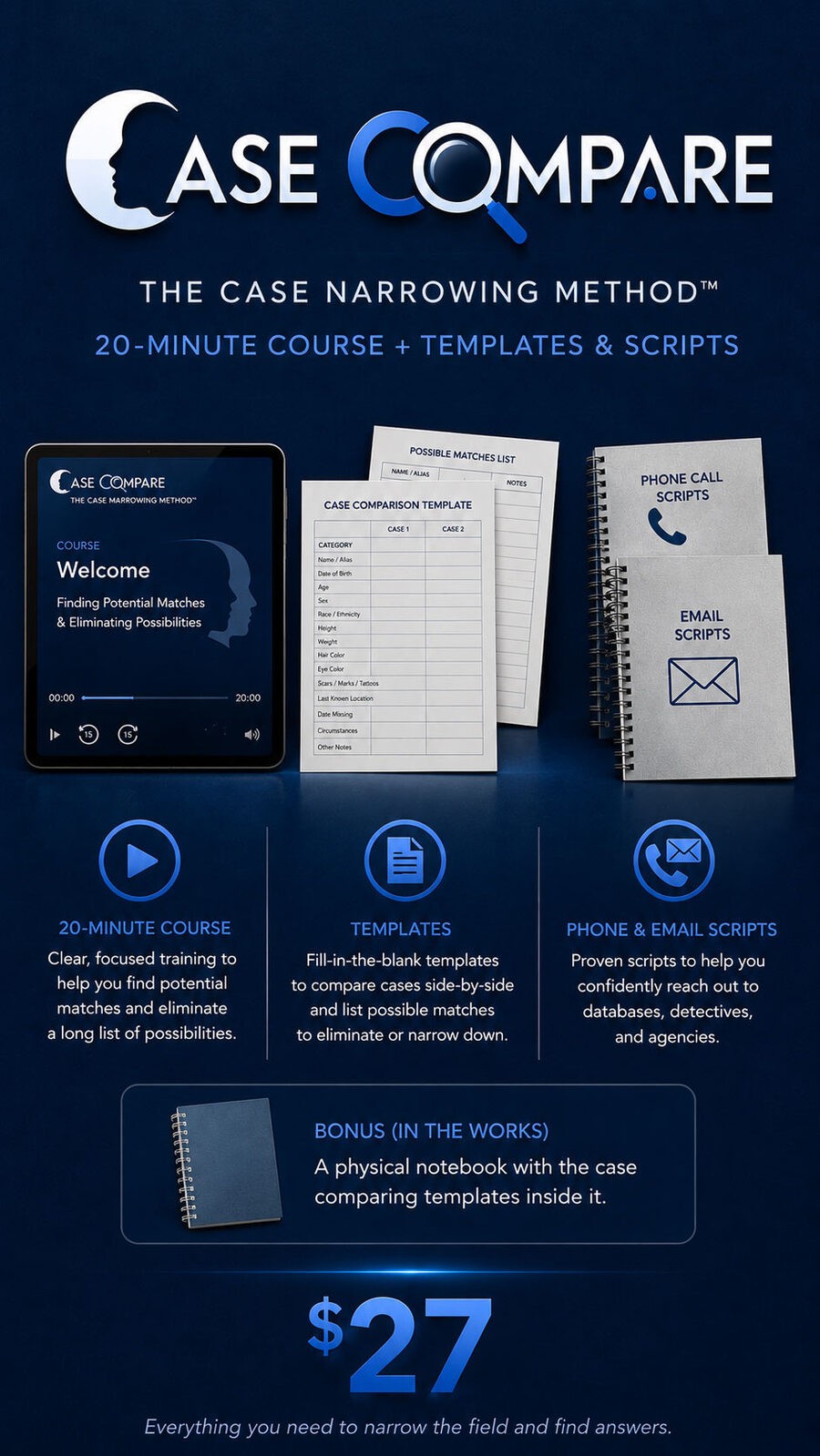
A 20-minute course, fill-in-the-blank comparison templates, and phone & email scripts for reaching databases, detectives and agencies. Nothing ships — it arrives by email.


 For volunteer researchers
Narrow the Possibilities. Advance Real Cases.
Learn a structured methodology for comparing missing & unidentified person cases, narrowing potential connections, and responsibly submitting leads that may help advance real cases.
A method, not an investigation
Case Compare provides a research methodology and organizational tools. It is not a law enforcement or investigative service.
Research from home
No boss, no required schedule, and no need to be part of law enforcement or a professional investigative organization.
Findings go to the case authority
The method ends where it should: documenting what you found and directing potential matches to the appropriate case authority.
Case Compare gives ordinary people, like stay-at-home moms interested in true crime, a structured way to learn how to compare real cases from home.
There’s no boss, no required schedule, and no need to be part of law enforcement or a professional investigative organization. You research independently, on your own time — after the kids are asleep, on a weekend afternoon, whenever you have it.
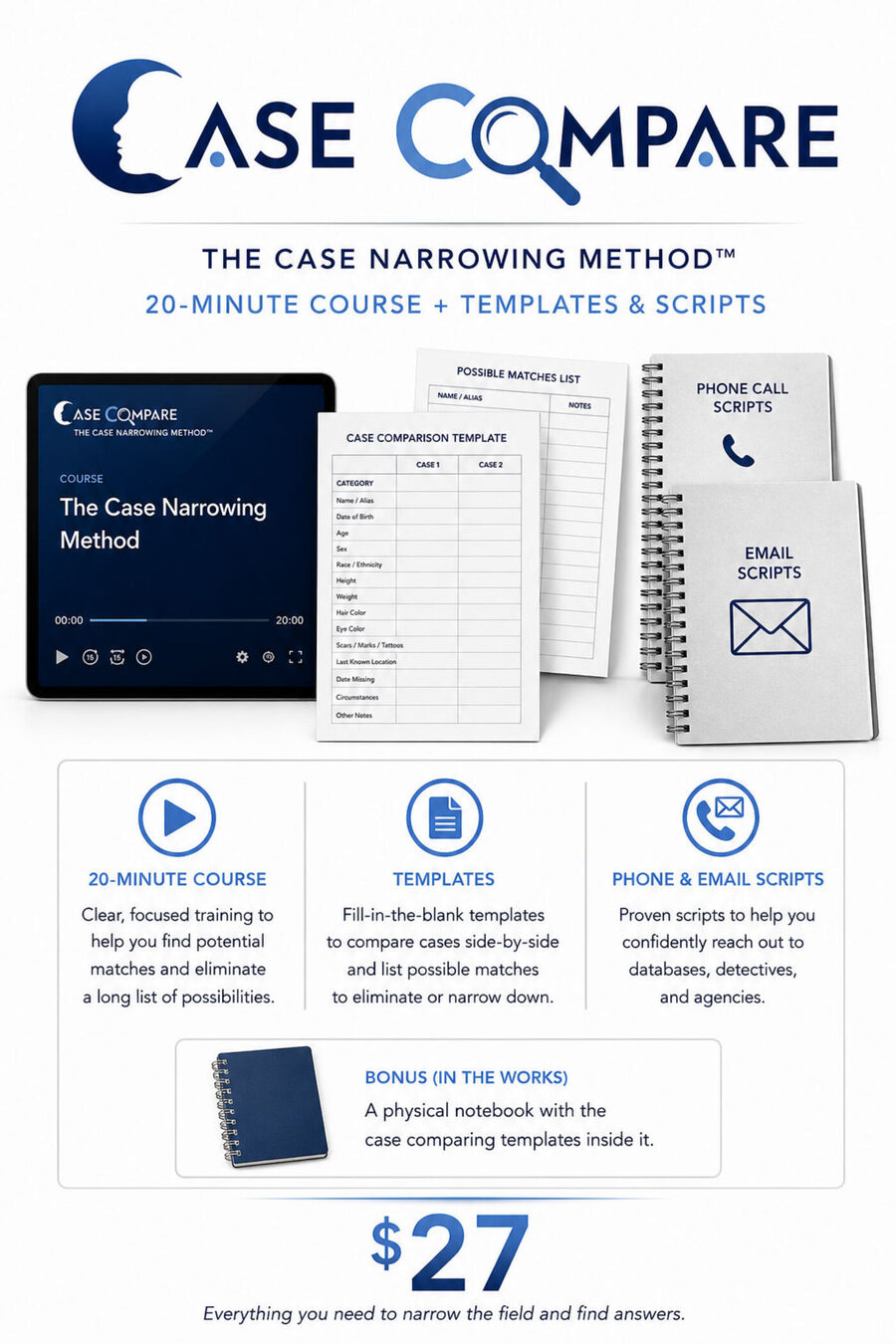
Everything you need to narrow the field and find answers.
Clear, focused training to help you find potential matches and eliminate a long list of possibilities.
Fill-in-the-blank templates to compare cases side-by-side and list possible matches to eliminate or narrow down.
Proven scripts to help you confidently reach out to databases, detectives, and agencies.
Why comparing details works
I started noticing that faces weren’t just something you recognized.
They were a collection of details.
And details could distinguish one person from another.
“A single feature could make someone look remarkably similar to another person. But that same feature could also rule them out. Then another feature would narrow it down again.”
That is the whole of the method: one detail at a time, until the list is short enough to document honestly.
You choose a real missing-person or unidentified-person case, then use our Case Narrowing Method course to learn how to compare the details side-by-side: age, height, location, dates, physical characteristics, clothing, jewelry, aliases, and other clues. You document what matches, rule out what doesn’t, and learn how to responsibly bring a potential match to the appropriate case handler. Then we have templates for helping write emails or make brief phone calls to detectives and case handlers. It’s designed to help organize and streamline the independent research you can do from home.
The goal isn’t to solve every case yourself. It’s to get better at recognizing potentially meaningful connections, documenting what you found, and knowing how to responsibly pass that information along to the people whose job it is to act on it.
Case Compare provides a research methodology and organizational tools. It is not a law enforcement or investigative service, and does not guarantee that any case will be solved. Always direct potential matches to the appropriate case authority.
Start with the method. Add the notebooks you’ll actually write in.
A 20-minute course, fill-in-the-blank comparison templates, and phone & email scripts for reaching databases, detectives and agencies. Nothing ships — it arrives by email.
The physical Case Compare workbook was designed around this process. It gives researchers dedicated spaces to track cases, compare identifying details side-by-side, record exclusions and discrepancies, and keep a submission log.
Your smaller, entry-level workbook.
The smallest way in · printed to order
The full 200-page spiral notebook.
200 pages · spiral bound
The upgraded faux-leather hardcover notebook.
Faux-leather · hardcover
Optional extras. You can add these at checkout, or order either one on its own.
A companion tool for systematically comparing the facial features of a missing person to an unidentified person.
If you think you have found something, it goes to the investigating agency — never onto a public post.
Two full-colour 6×9 sheets of tiny workflow stickers, designed for the Case Compare research process. Use them to quickly mark and organize your case-comparing worksheets, notes and research materials.
The printer for this item is not yet decided.
[Needs copy]How long a printed order takes to produce and arrive is not confirmed yet. Buyers should be told the lead time plainly, here and at checkout, rather than discovering it while they wait.
1 answer still to come. The rest are in her own words. The refund question is blocked on her refund policy.
You choose a real missing-person or unidentified-person case, then use our Case Narrowing Method course to learn how to compare the details side-by-side: age, height, location, dates, physical characteristics, clothing, jewelry, aliases, and other clues. You document what matches, rule out what doesn't, and learn how to responsibly bring a potential match to the appropriate case handler. Then we have templates for helping write emails or make brief phone calls to detectives and case handlers. It's designed to help organize and streamline the independent research you can do from home.
No. Case Compare is an independent, privately owned resource and is not affiliated with, employed by, or endorsed by any law enforcement agency or government organization.
Our goal is to teach everyday people how to responsibly research, compare, and document missing and unidentified person cases so they can identify potential connections and communicate relevant information to the appropriate case handlers.
Document what you found and carefully compare the available case information before drawing conclusions. If you believe you've identified a potential connection, use the appropriate official tip or contact information provided for the case and submit your information directly to the relevant case handler.
Case Compare teaches you how to organize your research, identify potential connections, and communicate your findings responsibly. A potential match is a lead, not a confirmed identification, so avoid contacting families, confronting individuals, or publicly sharing your suspected match.
No. Case Compare recommends that potential matches and relevant information be directed to the appropriate case handler or official tip channel rather than contacting a family directly.
Families may already be navigating an extremely difficult situation, and a potential match is not a confirmed identification. Allow the appropriate authorities or case handlers to evaluate the information and determine what should happen next.
[Needs copy]Blocked on her refund policy, which must not be invented.
Everything you need to narrow the field and find answers.
$27 · one-time · yours to keep